


Long Range Locators: Professional Solutions for Treasure Hunting and Underground Detection
In the world of treasure hunting and gold prospecting, one of the most ancient yet most advanced methods for scanning vast terrains and narrowing down a target is the use of Long Range Locators (LRL). Where a standard metal detector is limited by the diameter of its coil, long-range scanning systems step in, allowing you to analyze square kilometers of land in a very short time.
In this article, as Cotyora Dedektör, we will detail the working principles of long-range scanning rods, selection criteria, and the much-debated question: "Is gold-discriminating long-range scanning really possible?"
What is a Long Range Locator and How Does It Work?
Long-range scanning devices are designed to detect magnetic fields or ionized gases emitted by metals (gold, silver, copper) and structural voids (chamber tombs, cellars, tunnels) that have remained underground for many years.
Modern professional long-range scanning systems are generally categorized into two groups:
-
Static/Physical Rods: L-type rods or pendulum systems that orient towards the target using the user’s body bioelectricity.
-
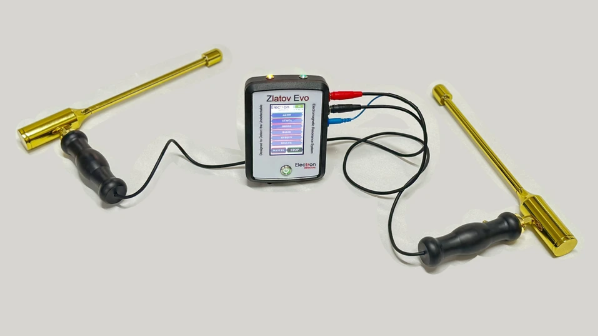
Electronic (Frequency Assisted) Locators: Advanced digital devices that transmit a specific metal frequency (e.g., gold frequency) into the ground and search only for that specific resonance.
Advantages of Using Long Range Locators
Searching a field with only a metal detector is like looking for a needle in a haystack. Long-range scanning rods provide you with several key advantages:
-
Time Efficiency: It allows you to scan wide areas in minutes and eliminate "empty" zones.
-
Depth Advantage: While many metal detectors are effective between 1-3 meters, a high-quality long-range system can detect signals from much deeper levels.
-
Void Detection: They are significantly more successful than standard detectors in finding structural cavities such as burial chambers, tunnels, and cellars.
How to Choose the Best Long Range Locator?
One of the most common questions in search engines is "Which is the best long-range locator?" The answer lies in the technology of the device. When purchasing a locator, you should pay attention to the following features:
1. Gold Discrimination
Ordinary rods may react to all types of metal or mineral concentrations. However, gold-discriminating long-range locators focus specifically on the frequency emitted by gold, protecting you from misleading signals like iron, nails, or trash metal.
2. Mineral Elimination
The soil in many regions is rich in minerals. A high-quality device should not react to "hot rocks" or mineralized soil and must focus solely on the actual buried object.
3. Digital Frequency Generator
Systems that transmit a signal into the ground via a main control unit increase accuracy by up to 80%. The advanced models offered by Cotyora Dedektör are equipped with this technology.
How to Use Scanning Rods? (Technical Tips)
Using a long-range locator is an art. Here are some professional tips to increase your efficiency:
-
Posture: Your body should be upright and your arms relaxed. The rods should be held neither too tight nor too loose.
-
Wind Factor: Physical rods can be affected by wind. If possible, hunt in non-windy weather or use closed-system models (rods rotating inside a tube).
-
Verification Method: Always double-check the point where the rods "cross" (X) or close from different angles (North-South, East-West).
Reach Your Target with Cotyora Dedektör!
Long-range scanning rods, your greatest assistant in the journey of treasure hunting, will lead you to results when combined with the right technology. At Cotyora Dedektör, we don't just sell devices; we also provide technical training and share our field experience with our users.
If you want to own a professional long-range scanning system and discover the secrets hidden underground, you can browse our product range and get support from our expert team. Remember: the right equipment is half the treasure!
Leave a comment